The Future of Hiring: 5 Insights from The Talent Collective Boston launch

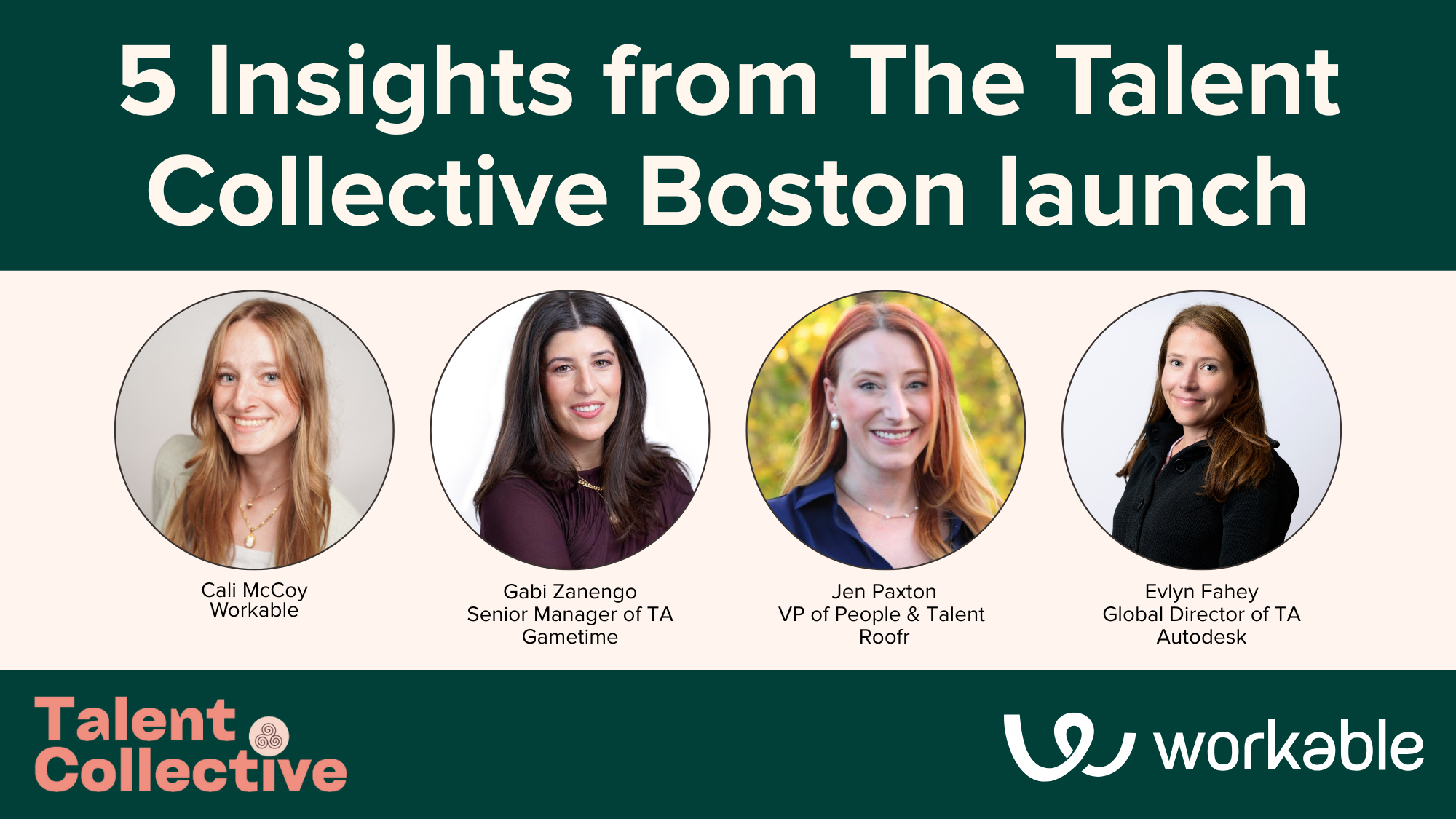
The Talent Collective Boston launch brought together a packed room of people leaders all eager to discuss the same question on everyone’s mind:
How can TA teams innovate quickly without losing what makes hiring fundamentally human?
Workable’s Cali McCoy moderated an honest and lively conversation with three powerhouse leaders:
- Jen Paxton, VP of People & Talent, Roofr
- Gabi Zanengo, Senior Manager of Talent Acquisition, Gametime
- Evelyn Fahey, Global Director of Talent Acquisition, Autodesk
Across industries and company sizes, their challenges were surprisingly consistent, and their perspectives painted a clear picture of what hiring will look like in 2026 and beyond.
1. Hyper-specialized roles are reshaping the recruiter playbook
The market has shifted away from high-volume hiring toward deeply niche, hybrid-skill roles. Teams are no longer searching for “more of the same,” they’re hunting for unique combinations (technical + creative, AI-literate + strategic, etc.).
This has forced a recalibration with hiring managers, grounding expectations in the reality of today’s talent pool. The message: you can have excellence, but not a unicorn.
2. Candidate volume is exploding and overwhelming TA teams
While roles are getting narrower, applicant counts are ballooning, some reaching 1,000+ applicants per req.
This spike is creating:
- Faster bottlenecks
- Shallow résumé review (i.e., “I screened the first 20…”)
- Reduced confidence in early funnel decision-making
It’s accelerating the need for AI support in screening, done in a transparent and ethical way.
3. Candidate fraud is becoming one of TA’s biggest threats
No topic got more nods in the room.
Teams are battling:
- Applicants interviewing with AI assistance
- Fake résumés circulating in patterns
- VPN-masked locations
- Multi-job “triple dippers” working several full-time jobs
- Identity-mismatch hires uncovered only after the fact
Leaders are adopting creative tactics, from IP checks to location validation to identity verification, to protect both candidate experience and organizational integrity.
4. AI adoption is accelerating, but maturity varies widely
Every company is “somewhere different on the map.” Some are experimenting rapidly with:
- AI interview assistants
- Automated scheduling
- Screening tools for volume roles
- Internal copilots embedded into workflows
Others are encountering legal and compliance friction. One standout insight:
Instead of asking legal “Can we do this?”, ask “Under what conditions would this not be allowed?”
This reframes experimentation as controlled, not risky.
Across the board, TA teams are aligning on one principle: AI should eliminate admin, not become the decision maker.
5. Candidate experience is moving toward continuous feedback
Teams are shifting from a single end-of-process survey to quick, stage-by-stage check-ins that surface friction earlier. Instead of waiting until candidates are rejected or hired—when feedback is most emotional—TA teams can now spot issues in real time, whether it’s unclear communication, interview inconsistency, or process delays.
Not every candidate will respond, and that’s okay. The goal isn’t volume, it’s early signals that help teams adjust the process while candidates are still in it.
The Bottom Line
Hiring is in the middle of its most dramatic shift in a decade. The conversation in Boston made one thing clear:
AI will transform the process, but people will continue to define the experience.
As complexity grows, the real advantage will belong to teams who balance:
innovation + integrity + automation + empathy + speed + substance
And those are exactly the qualities that showed up in the room!